
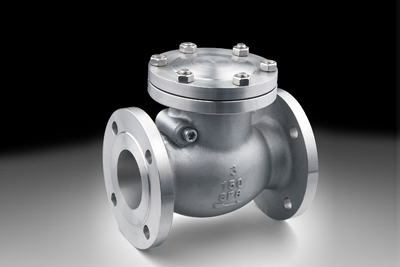
What is a check valve?
The check valve refers to a valve that automatically opens and closes the valve flap by means of the flow of the medium itself, and is used to prevent the back flow of the medium, which is also called a check valve, a check valve, a reverse flow valve, and a back pressure valve.
Check valve function
The check valve is an automatic valve whose main function is to prevent backflow of the medium, prevent the pump and drive motor from reversing, and discharge the container medium. The check valve can also be used to supply a line in which the pressure may rise to an auxiliary system that exceeds the system pressure.
Check valve classification
The check valve can be divided according to its structure and installation method:
Swing-type check valve: The valve flap of the swing-type check valve has a disk shape and rotates around the rotation shaft of the valve seat passage. Since the valve passage is streamlined, the flow resistance is smaller than that of the lift check valve. It is suitable for large diameter applications where low flow rate and flow are not changing frequently, but it is not suitable for pulsating flow, and its sealing performance is not as good as lifting type. The swing-type check valve is divided into three types: single-valve, double-valve and multi-half. These three forms are mainly divided according to the valve diameter. The purpose is to prevent the hydraulic shock from being weakened when the medium stops flowing or reverses.
Lift check valve: the check valve sliding along the vertical centerline of the valve body, the lift check valve can only be installed on the horizontal pipe, and the ball can be used on the high pressure small diameter check valve. The shape of the lift check valve is the same as that of the shut-off valve (common to the shut-off valve), so its fluid resistance coefficient is large. Its structure is similar to the stop valve, the valve body and the valve flap are the same as the shut-off valve. The upper part of the valve flap and the lower part of the valve cover are machined with a guide sleeve, and the valve guide can be easily lifted and lowered in the valve guide guide. When the medium is downstream, the valve flap is opened by the medium thrust. When the medium stops flowing, the valve flap is self-retained. The drooping falls on the valve seat to prevent the medium from flowing back. The direction of the inlet and outlet passages of the straight-type lifting check valve is perpendicular to the direction of the valve seat passage; the vertical lift check valve has the same direction of the medium inlet and outlet passages as the valve seat passage, and its flow resistance is smaller than that of the straight-through type.
Disc check valve: A check valve that rotates around the pin in the seat. The disc type check valve has a simple structure and can only be installed on a horizontal pipe, and the sealing property is poor.
Pipeline check valve: A valve that slides along the centerline of the valve body. Pipeline check valve is a new type of valve. It is small in size, light in weight and good in processability. It is one of the development directions of check valves. However, the fluid resistance coefficient is slightly larger than the swing check valve.
Compact check valve: This valve is used as a boiler feed water and steam shut-off valve. It has a comprehensive function of a lift check valve and a shut-off valve or an angle valve.